How Node.js Handles Multiple Requests with a Single Thread
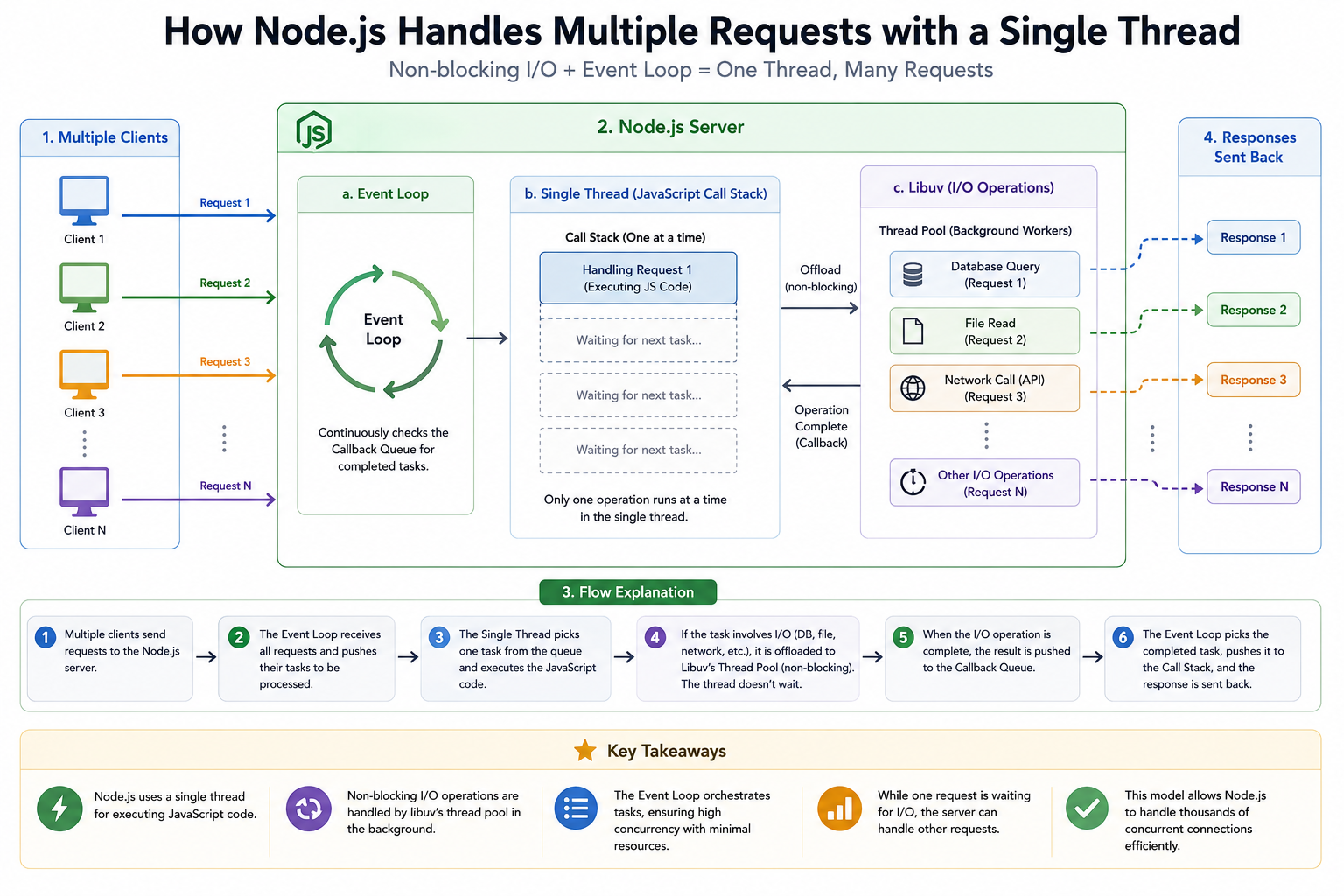
At first glance, the architecture of Node.js sounds like a recipe for a bottleneck. If you are building a high-performance backend like a real-time trading platform or a complex microservice relying on a single thread seems counterintuitive. How can one thread serve thousands of concurrent users without everything grinding to a halt?
The secret lies in understanding that Node.js doesn't work harder; it works smarter. By mastering concurrency rather than brute-forcing parallelism, Node.js flips traditional server architecture on its head.
Let’s break down exactly how Node handles multiple requests, why it delegates the heavy lifting, and why this single-threaded model scales so beautifully.
1. The Basics: Threads, Processes, and Concurrency
Before we dive into Node.js, we need to clear up a few foundational concepts:
Process vs. Thread: Think of a process as a factory. It has its own memory space and resources. A thread is a worker inside that factory. A factory (process) can have one worker (single-threaded) or many workers (multi-threaded) sharing the same tools.
Parallelism vs. Concurrency: Parallelism is having multiple workers doing different tasks at the exact same time (like cooking a steak while someone else chops vegetables). Concurrency is one highly efficient worker juggling multiple tasks by switching between them during idle time (like putting a steak on the grill, and while it cooks, pivoting to chop vegetables).
Traditional web servers (like Apache or Spring Boot) rely on parallelism. When a new request comes in, they spawn a brand new thread (a new worker) to handle it. Node.js relies entirely on concurrency.
2. The Restaurant Analogy: Why Multi-Threading Can Be Inefficient
Imagine a busy restaurant.
In a multi-threaded server model, every time a customer walks in, the restaurant hires a dedicated waiter just for them. The waiter takes the order, walks to the kitchen, and stands there doing nothing until the food is ready. Once the food is served, the waiter is fired. If 1,000 people show up, you need 1,000 waiters. This consumes massive amounts of resources (memory and CPU context-switching).
In the Node.js model, there is only one incredibly fast waiter (the single main thread).
The waiter takes Customer A's order and passes it to the kitchen.
Instead of waiting for the food, the waiter immediately pivots and takes Customer B's order, then Customer C's order.
When the kitchen finishes Customer A's food, they ring a bell.
The waiter grabs the food, drops it off at Table A, and goes right back to taking orders.
This is asynchronous, non-blocking I/O in a nutshell.
3. Under the Hood: The Event Loop and Background Workers
If the main thread is just taking orders, who is actually cooking the food?
While it's true that JavaScript execution in Node.js is single-threaded, the Node.js runtime itself is not. When your Express server receives a request that requires heavy lifting—like querying a PostgreSQL database, reading a file, or making an external API call—the main thread doesn't execute that task.
Instead, it delegates the task to the underlying system via a C++ library called Libuv.
Here is the exact flow of a request:
The Request Arrives: The single main thread receives the HTTP request.
Delegation: If the request involves blocking I/O (like a database query), the main thread offloads it to Libuv's pool of background worker threads.
The Event Loop: The main thread immediately moves on to the next incoming request. Meanwhile, the Event Loop constantly spins, checking the status of those background tasks.
The Callback: Once a background worker finishes the database query, it places the result (and its associated callback function) into a queue.
Execution: The Event Loop picks up the callback and hands it back to the main thread, which sends the final JSON response back to the client.
4. Why Node.js Scales So Well
So, why choose this single-threaded, event-driven architecture? Resource efficiency.
Threads are expensive. Every time a traditional server spawns a new thread, it eats up a chunk of RAM (often a few megabytes) and requires CPU cycles to switch contexts between threads. If you have a sudden spike in traffic, a multi-threaded server can quickly exhaust its memory and crash.
Because Node.js only uses a single main thread and delegates I/O tasks to a highly optimized background pool, its memory footprint is incredibly small. It can easily keep tens of thousands of concurrent connections open without breaking a sweat. This makes it the perfect architecture for data-intensive, real-time applications like streaming services, chat applications, or handling high-frequency API requests.
The Golden Rule: Node.js will scale beautifully as long as you respect its architecture. Because there is only one waiter, you must never give them a task that takes 10 minutes to complete (like heavy image processing or complex mathematical loops directly in JavaScript). If you block the main thread, the whole restaurant stops. But if you keep it focused on routing traffic and delegating I/O, Node.js is an unstoppable, scalable powerhouse.


